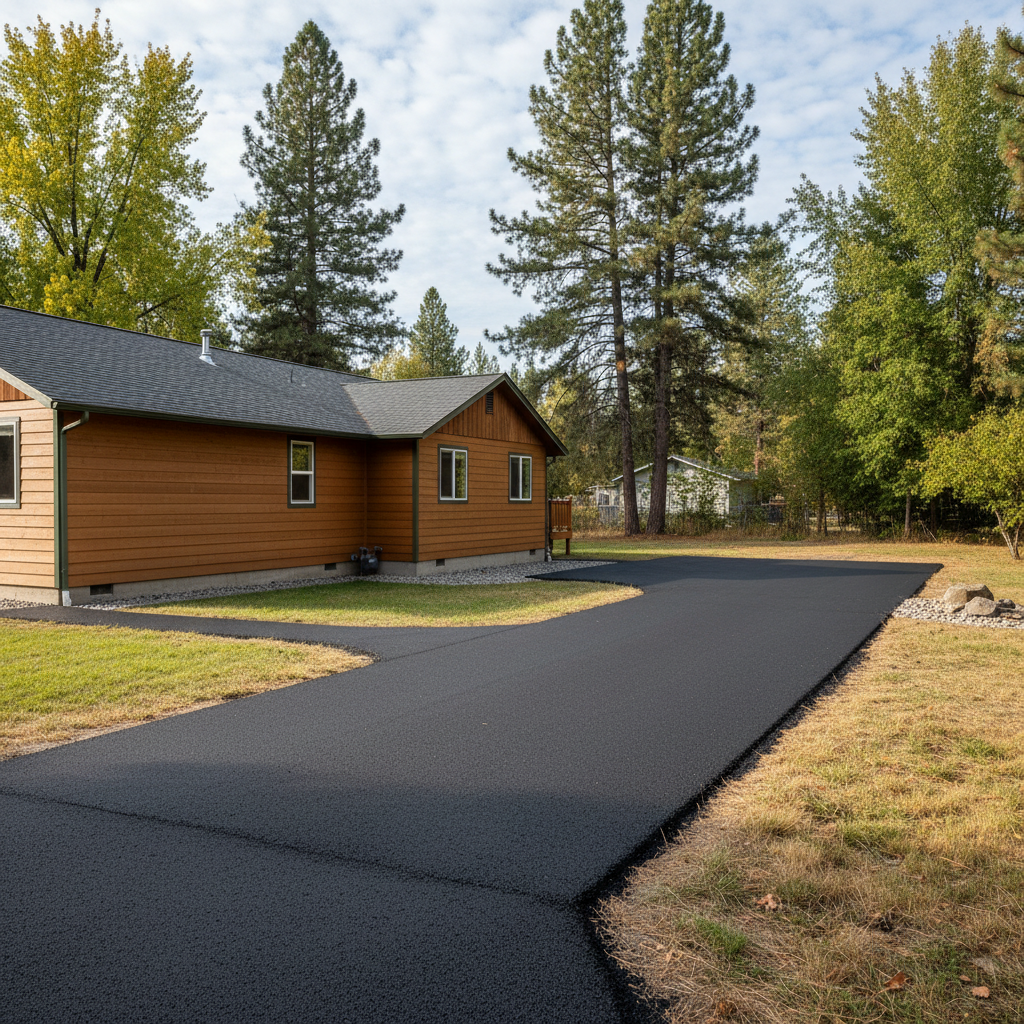
Alright, let's talk about getting a new asphalt driveway here in Klamath Falls. It's a pretty big investment for your home, and honestly, nobody wants to feel like they're getting ripped off. I get calls all the time asking, "How much does a new driveway cost?" And while the answer always starts with "it depends," I'm going to break down what those 'depends' actually mean for your wallet.
What Really Affects Your Driveway Paving Price?
You might think it's just about the square footage, but a lot more goes into pricing a paving job. Here's what we look at:
- Size and Shape: Yeah, square footage is a big one. A small, straight driveway costs less per square foot than a large, winding one with lots of curves or odd angles. More complex shapes mean our crew spends more time, and we might need more specialized equipment.
- Existing Surface & Prep Work: Is this a brand-new install on untouched ground? Or are we tearing out an old, cracked concrete or gravel driveway? If we're removing old material, that's extra labor and disposal costs. If the base isn't solid — like in some of those older homes near the Link River where the soil can be a bit soft — we might need to do extra excavation and bring in more aggregate for a stable foundation. A good, solid base is critical for a long-lasting driveway, especially with our freeze-thaw cycles here in Klamath Falls.
- Asphalt Thickness: Standard residential driveways usually get 2 to 3 inches of compacted asphalt on top of a good aggregate base. If you've got heavier vehicles, say an RV or a work truck, you might need a thicker layer. That means more material and a higher price.
- Accessibility: Can our big paving equipment get to your driveway easily? If it's a tight spot, or we have to haul material a long way from where the truck can dump, that adds time and labor.
- Material Costs: The price of asphalt mix fluctuates with crude oil prices. We don't control that, but it definitely impacts what we pay and, consequently, what you pay.
- Drainage: Proper drainage is huge. If your property needs grading or a drain installed to prevent water pooling on your new asphalt, that's an additional cost. But it's a necessary one to protect your investment, wouldn't you agree?
Typical Cost Ranges for a New Residential Driveway
Okay, let's get down to some numbers. Remember, these are estimates for Klamath Falls and the surrounding area, and they can change. Generally, you're looking at:
- Small Driveway (200-400 sq ft): Think a single-car width, maybe 20-30 feet long. You could be looking at anywhere from $2,000 to $4,500. This often includes basic prep and a standard asphalt layer.
- Medium Driveway (400-800 sq ft): This is your typical two-car width, average length driveway. For these, expect to pay roughly $4,500 to $8,000. Again, this assumes standard conditions.
- Large Driveway (800+ sq ft or complex): If you've got a long, winding driveway, a large parking pad, or need significant excavation, the costs can climb. You're probably looking at $8,000 to $15,000+. For really big or complex jobs, it could go even higher.
Most residential jobs we do at Summit Asphalt Inc. fall into the range of $5 to $10 per square foot, but that's a very rough average and depends heavily on the factors I just mentioned.
What Should Be Included in Your Quote?
A good, detailed quote from a reputable contractor should spell out exactly what you're paying for. Here's what you want to see:
- Site Preparation: This covers excavation, grading, and compacting the sub-base.
- Base Material: The type and thickness of the aggregate base (e.g., 6 inches of compacted crushed rock).
- Asphalt Application: The number of layers and the compacted thickness of the asphalt (e.g., 2.5 inches of compacted asphalt).
- Transition Work: How the new driveway will meet your garage, sidewalk, or the street.
- Cleanup and Disposal: What happens to the old material if it's removed.
- Warranty: What kind of guarantee do they offer on their work?
- Permits: If any local permits are required, who is responsible for getting them?
If a quote is just a single line item with a dollar amount, be wary. You really need to know what you're getting for your money.
How to Avoid Overpaying for Your Driveway
It's your money, so be smart about it.
- Get Multiple Quotes: Don't just go with the first guy. Get at least three detailed quotes from different local paving companies. This helps you compare apples to apples.
- Check References & Reviews: Look up their work. Ask for local references. A good contractor will have plenty of happy customers.
- Ask Questions: If you don't understand something in the quote, ask! A good contractor will take the time to explain it to you.
- Don't Chase the Lowest Price: The cheapest bid isn't always the best. Sometimes a super low price means they're cutting corners on materials or labor, and you'll pay for it later with premature cracking or failure.
- Understand the Scope: Make sure every contractor is bidding on the exact same scope of work. If one contractor includes extensive base prep and another doesn't, their prices will be very different, but you're not comparing the same job.
A new asphalt driveway is a big deal, and when it's done right, it adds value and curb appeal to your home for years. Take your time, do your homework, and you'll end up with a great product.